
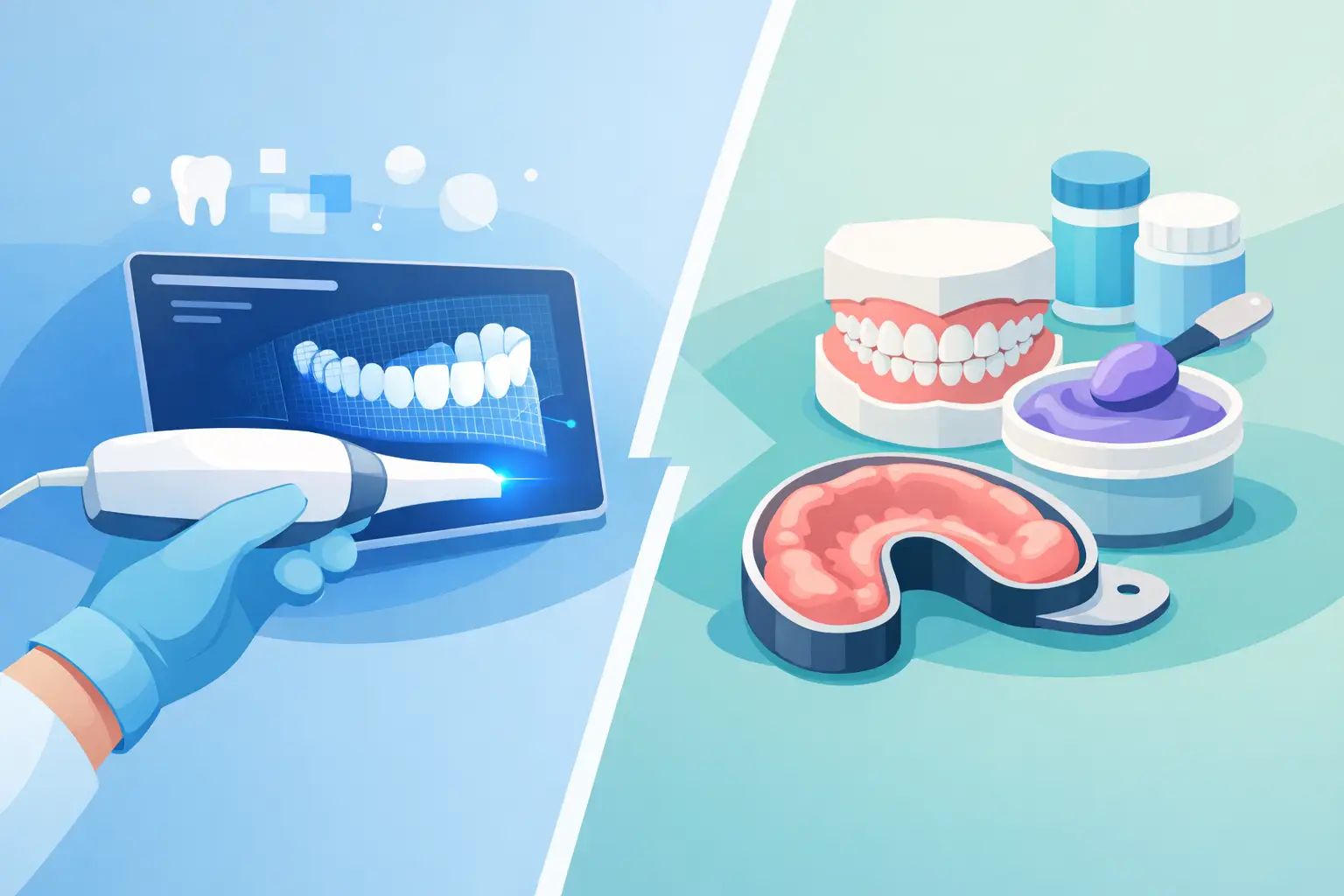
A crown, bridge, night guard, or clear aligner often starts with one practical question: how will your dentist capture the shape of your teeth? The choice between an intraoral scanner versus impressions can affect comfort, timing, and the type of information sent to the dental lab. Both methods can support excellent treatment. The right one depends on your mouth, the procedure, and the clinical details your dentist needs to see.
For many patients, the biggest difference is simple. A digital scan uses a small handheld camera to create a 3D model of your teeth. Traditional impressions use a tray filled with dental material that sits over the teeth while it sets. If you have ever felt nervous about gagging during an impression, a scan may sound like a welcome alternative. Still, traditional impressions remain useful in certain situations and are not automatically the less accurate choice.
What Is an Intraoral Scanner?
An intraoral scanner is a small device that takes many detailed images as your dentist moves it around your teeth and gums. Software combines those images into a digital model of your mouth. Your dentist can review the model right away, identify areas that may need another pass, and send the digital file to a dental lab when appropriate.
The scanning process does not involve a mouthful of impression material. You will usually be asked to open comfortably while the scanner captures different surfaces of your teeth. It may take a few minutes, depending on the treatment and the number of teeth being scanned.
Digital scans can be used for many types of care, including crowns, bridges, veneers, clear aligners, retainers, night guards, and some dentures. They can also help dentists document changes in your teeth over time or plan certain restorative treatments.
What Are Traditional Dental Impressions?
Traditional impressions use a tray and a soft material, often similar in texture to thick putty, to make a physical mold of your teeth and surrounding tissues. The tray stays in place while the material sets. The finished mold is then used directly or sent to a lab to create a model.
This approach has been used in dentistry for many years because it can record detailed information when taken carefully. Modern impression materials have improved greatly, and many patients still complete the process without difficulty.
The main challenge is comfort. Some people dislike the feeling of a full tray, especially on the upper teeth. Others have a strong gag reflex, nasal congestion, anxiety about dental visits, or difficulty keeping their mouth open for the required time. In those cases, a digital scan may be easier to tolerate.
Intraoral Scanner Versus Impressions: Key Differences
The most noticeable difference is the patient experience. With a scanner, there is no tray of material covering your teeth. If you need a break, the scan can often be paused and continued. A traditional impression requires the tray to stay still while the material sets, which can feel more demanding for some patients.
Digital scanning also gives the dental team a chance to review the image immediately. If a tooth edge or another important area was not captured clearly, it can be scanned again before you leave. With a physical impression, an issue may not be noticed until the mold is inspected or reaches the lab, which can occasionally mean repeating the appointment.
Accuracy is more nuanced than a simple digital-versus-traditional comparison. Both can be highly accurate when used properly. A scanner may work particularly well for many single crowns, smaller bridges, aligner cases, and guards. However, certain situations involving extensive restorative work, areas below the gumline, significant saliva control challenges, or a full-arch rehabilitation may call for a particular scanning approach, a traditional impression, or sometimes both.
Your dentist is not choosing a method based only on what is newest. The goal is to collect a reliable record that supports a restoration or appliance that fits properly.
Comfort and gag reflex concerns
For patients who gag easily, a scanner can be a meaningful improvement. The scanning wand is still placed inside the mouth, but it does not cover the palate or require bulky material to set. Many people find this easier, especially if they communicate their concerns before the appointment.
Traditional impressions can still be manageable with planning. Sitting more upright, breathing through the nose, taking breaks when possible, and using an appropriately sized tray may help. Let your dental team know if past impressions were difficult. That information helps them choose the most comfortable practical option.
Time in the dental chair
A digital scan may shorten some parts of the process because the file can be reviewed and transferred electronically. However, the overall appointment time depends on more than the scan. Preparing a tooth for a crown, checking bite alignment, selecting a tooth shade, and discussing aftercare all take time.
Likewise, a traditional impression is not always a long appointment. For a straightforward case, it may be completed efficiently. It is better to think of scanning as a tool that can improve workflow in the right case, rather than a guarantee of a faster visit every time.
Fit, adjustments, and final results
A well-fitting crown or appliance depends on careful planning from start to finish. That includes the health of the tooth and gums, the preparation, the quality of the scan or impression, the lab work, and the final adjustment. A digital scan does not remove the need for careful clinical work, just as a traditional impression does not mean a restoration will be less precise.
At the final appointment, your dentist checks the fit, bite, contact points, and appearance of the restoration. Small adjustments can be normal. The priority is a result that feels comfortable and functions well when you bite and chew.
When Might Your Dentist Recommend One Method Over the Other?
Your dentist may recommend a digital scan when you need an aligner, retainer, night guard, crown, or another treatment that is well suited to digital records. It can also be a good choice if you have had trouble tolerating impression trays in the past.
A conventional impression may be recommended when it is better suited to the design of your treatment, the type of restoration being made, or the specific information required by the dental lab. In some cases, your dentist may scan first and use an impression only if additional detail is needed.
The condition of your gums matters too. If gums are swollen or bleeding around a prepared tooth, capturing a clear edge can be more difficult with any method. Your dentist may first focus on gum health, use techniques to manage the tissue, or schedule the final record when the area is ready.
What About Cost and Insurance Coverage?
For patients, the cost is generally tied to the treatment itself rather than the recording method alone. For example, coverage for a crown is based on your insurance plan’s rules for crowns, deductibles, annual maximums, and eligibility, not simply whether a scanner or impression was used.
Before starting treatment, ask what is included in the estimate and whether a scan or impression carries a separate fee in your case. Clear answers are especially helpful when planning care for several family members or coordinating treatment around insurance benefits.
At Parliament Street Dentistry, the team can discuss expected costs before treatment and help make the insurance process more straightforward through direct billing. Coverage varies by plan, so reviewing your individual benefits before moving ahead can prevent surprises.
How to Prepare for a Scan or Impression Appointment
You do not need to do much special preparation. Brush and floss as you normally would, and arrive ready to share any concerns about gagging, anxiety, jaw discomfort, or past difficult appointments. If you have a removable appliance, retainer, or night guard, bring it if your dentist has asked you to do so.
During the visit, speak up if you need to pause. Dental records are most useful when you can stay reasonably comfortable and the team can work carefully. A few extra moments to adjust your position or take a breath are worthwhile.
The best choice is the one that gives your dentist the information needed for safe, predictable care while making the appointment easier for you. If you are considering a crown, aligner, guard, or other custom dental treatment, book a consultation and ask which option fits your needs. A clear conversation before treatment can make the next step feel much more manageable.